Case Study:
AI Proof of Concept: Validating Technical Feasibility Before You Build
Most founders spend months building AI products only to discover the technology can't deliver what they need.
There's a better way: Run an AI proof of concept before you commit.
This is how we helped Summit Trails — experienced operations consultants — answer whether AI could power their platform in 4 weeks, not 4 months.
The client
Steve Campbell and Wendy Kinney have 35+ years in operations consulting. They built Activity-Based Management (ABM), a proven methodology that consistently delivers results for Fortune 500 companies.
The problem: Every implementation required weeks of manual work and expensive custom integrations.
Steve's hypothesis: Could AI observe work from screenshots and eliminate integration costs entirely?
They had a working proof-of-concept. But they needed answers:
Can this achieve 98% accuracy?
How do we handle privacy in regulated industries?
What would it take to build this?
They came to us for Step Zero: Technical Validation — not to build, but to answer whether this was even possible.
The Challenge: Accuracy and Privacy in Regulated Industries
Summit Trails (currently in stealth mode) had two non-negotiables:
1. 98% Accuracy. Below this, supervisors won't trust the data. The value proposition collapses.
But foundation models are non-deterministic. Accuracy isn't guaranteed — it's a research question.
2. Zero PII/PHI to External Cloud. Target customers: credit unions, insurance, healthcare. One data breach = product dies at CTO level.
The catch: AI needs rich visual data, but screenshots contain Social Security numbers, medical records, and financial data.
The real question: How do you validate AI feasibility with these constraints?
Most companies guess. We researched.
Our Approach: A 4-Week AI Feasibility Study
Weeks 1-2: Deep Discovery
We researched:
What "98% accuracy" means in production (per activity? per user? edge cases?)
What CIOs in regulated industries actually demand
State-of-the-art Visual Language Models (early 2025)
Key insight: Privacy isn't about obfuscation — it's about architectural boundaries.
Weeks 2-3: The Critical Pivot
Initial approach: Blur screenshots → Send to cloud API → Get results.
Simple. Lower cost. No client infrastructure.
Then Steve asked: "If I'm a CIO, would I approve screenshots leaving my network — even blurred?"
Answer: "I would reject this immediately."
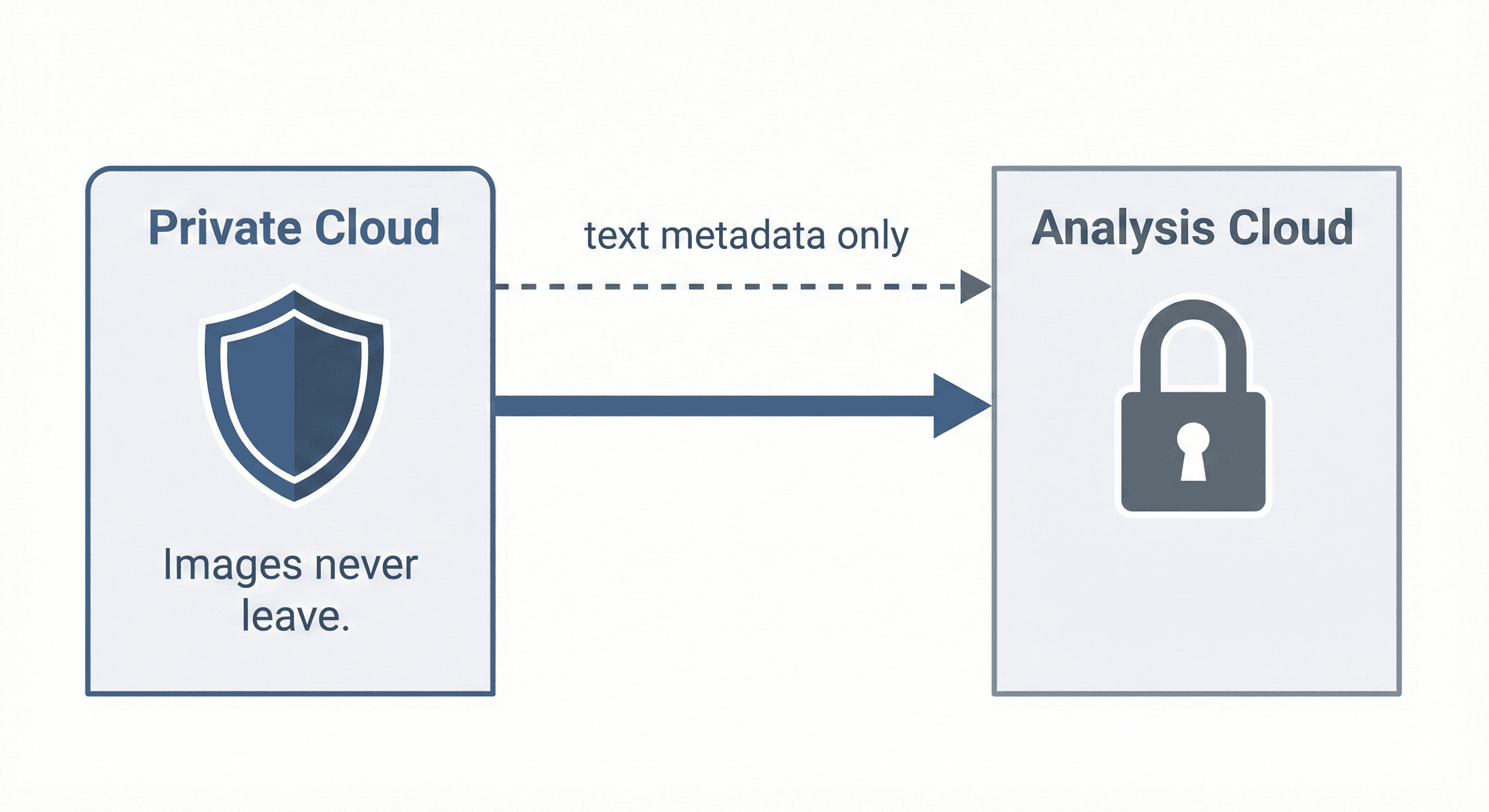
The pivot: Process images in client's private cloud using local VLM. Screenshots never leave their network. Only text metadata goes to our cloud.
This tripled development complexity — 8 integrated systems instead of 2, GPU hardware costs, per-client deployment engineering.
But it made enterprise adoption possible. Privacy and accuracy aren't trade-offs — they're both non-negotiable.
Weeks 3-4: Roadmap
We designed 8 integrated systems and a 3-phase build plan (20 weeks total) with Go/No-Go gates:
Phase 1: AI R&D validation (if 98% isn't achievable, stop here)
Phase 2: Core platform build
Phase 3: MVP enrichment
We delivered complete technical documentation: PRD, architecture diagrams, database schema, security design, evaluation strategy, and cost models.
The Critical Moment: CIO Validation
Steve validated our architecture with 3 independent CIOs (startup, credit union, utility company).
The unanimous feedback:
Enhanced obfuscation: "I would reject this immediately"
Local VLM: "This could pass our security review"
Real buyer feedback before writing a single line of code. The path forward was clear.
What We Delivered
We didn't oversell, overpromise, or guess. We delivered evidence, not enthusiasm. After 4 weeks, Summit Trails received:
Technical Feasibility
98% accuracy is achievable through dual agentic workflows with local VLM processing and optional cloud validation.
Privacy Architecture
Zero-image-to-cloud design validated by 3 CIOs. Images stay in client's private cloud; only sanitized text metadata transmitted.
Complete Roadmap
20-week phased build plan, 8 integrated systems, Go/No-Go gates, complete technical documentation.
Go/No-Go Clarity
Summit Trails knows exactly what's feasible, what it takes to build, and the phased investment required.
Client Testimonial
Steve Campbell, Co-Founder of Summit Trails
Founder
The DevDash team was responsive, easy to work with and worked tirelessly to understand our needs and path forward. They're highly professional, subject matter experts, easy to work with, timely. They created a roadmap for development of our flagship AI-enabled Performance Intelligence Platform.
What Makes DevDash Labs Different
We're an Applied AI Research and Development company, not a dev shop. Most AI consulting services say "Yes, we can build that" and start writing code. We say: "Let's find out if AI can actually do this first."
Research-First
We research state-of-the-art capabilities, real constraints, and buyer requirements. Evidence-based roadmaps, not vendor promises.
Technical Co-Founder Model
Fractional technical leadership deployed on your team, sharing risk and aligning with your success.
Systematic Validation
4-week AI feasibility study with deep discovery, architecture design, and phased roadmaps — validated with real buyers before building.
Radical Transparency
We surface hard truths early. Better to pivot in week 3 than month 6.
Cutting Through Hype
We tell you what AI can do today, what accuracy is achievable, and what it actually takes to build. No overselling.
When You Need an AI Feasibility Study
You might need Step Zero if you:
Have a proven process and wonder if AI can scale it
Are asking "Can AI do this?" with today's technology
Have non-negotiable constraints (accuracy, privacy, compliance)
Want to de-risk before spending hundreds of thousands
Value evidence over enthusiasm
Ready to Validate Your AI Proof of Concept?
Have a proven process you want to productionalize with AI? Don't guess if it's possible.
After 4 weeks, you'll walk away with:
Technical feasibility validation (can AI achieve your requirements?)
Enterprise-grade architecture design validated by real buyers
Complete development roadmap with Go/No-Go gates
Clear answer backed by evidence (or a "No" that saves hundreds of thousands)
This is Step Zero: Validate before you build.
About DevDash Labs
DevDash Labs is an Applied AI Research and Development company that ignites the AI revolution within organizations.
Mission: Cut through AI hype and deliver research-backed solutions that create lasting impact.
What Sets Us Apart:
Research-Backed Innovation: Direct connection between cutting-edge research and implementation
Implementation-First Mindset: Building and deploying solutions that work today, not tomorrow
Deep Technical Expertise: Team brings AI technology, cloud infrastructure, and business optimization experience
Services: AI Feasibility Validation (Step Zero), Technical Co-Founder Partnership, Fractional AI R&D Leadership
This case study was published with permission from Summit Trails. Some product details have been omitted to respect their stealth mode development.